

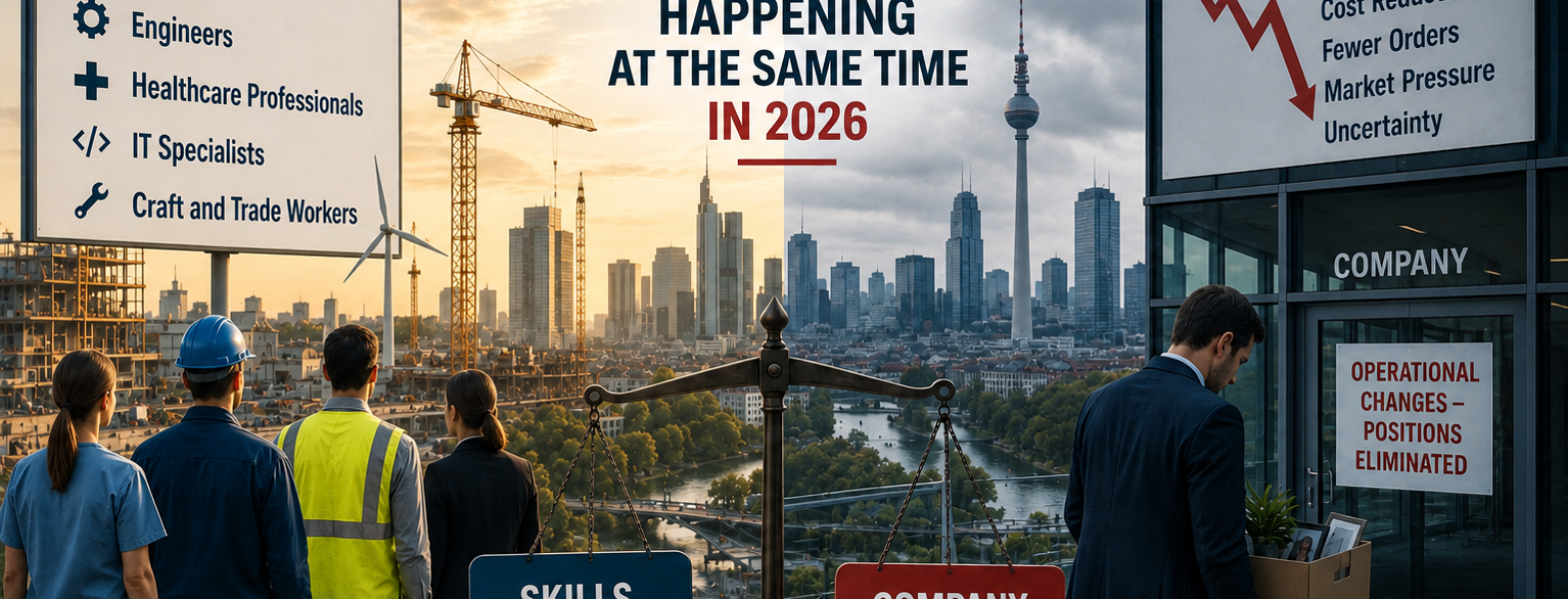
If you’ve been following Germany’s economy recently, you’ve probably noticed something that seems impossible. One day, you read headlines about companies struggling to find workers. On another day, you see reports of layoffs at major employers. This naturally raises a question: How can Germany have labor shortages and layoffs at the same time?
At first glance, it looks like a contradiction. In reality, both developments are happening simultaneously—and understanding why is crucial for anyone planning to build a career in Germany.
The answer lies in a concept many economists call a skills mismatch: employers are not simply looking for more workers; they are looking for workers with very specific skills, qualifications, and experience.
TL;DR
- Germany continues to face genuine labor shortages in many occupations.
- At the same time, some industries are restructuring and reducing headcount.
- The issue is often not a shortage of people, but a shortage of specific skills.
- Sectors such as healthcare, nursing, construction, logistics, education, and certain technical fields continue to face hiring challenges.
- Expats who align their skills with growing sectors are likely to have better opportunities despite economic uncertainty.
Germany’s Labor Shortage Is Real
Let’s start with the first part of the puzzle. According to the Federal Employment Agency (Bundesagentur für Arbeit), Germany continues to experience shortages in 163 occupations, particularly in areas such as:
- Nursing and healthcare
- Construction
- Skilled trades
- Transportation and drivers
- Early-years education
The agency’s latest shortage analysis shows that many employers are struggling to fill vacancies even when positions remain open for extended periods.
This challenge is largely driven by demographics. Germany has one of the oldest populations in Europe, and many experienced workers are retiring faster than they can be replaced. As a result, labor shortages remain a long-term structural issue rather than a temporary problem.
Yet Layoffs Are Also Increasing
At the same time, some of Germany’s largest companies have announced restructuring measures, hiring freezes, or workforce reductions. Recent reports from the ifo Institute’s Employment Barometer indicate that many companies have become more cautious about hiring due to economic uncertainty. Several factors are contributing to this:
- Weak economic growth
- High energy costs
- Global competition
- Slower industrial demand
- Technological change
In particular, some traditional industries are under significant pressure. This is especially visible in parts of manufacturing and the automotive sector.
The Automotive Industry Is a Perfect Example
Germany’s automotive industry illustrates this contradiction well. For decades, the sector was a major source of employment and economic growth. Today, however, the industry is undergoing one of the biggest transformations in its history. Manufacturers face pressure from:
- Electric vehicle adoption
- Competition from Chinese EV manufacturers
- Digitalization
- Automation
- Changing consumer demand
As a result, some roles connected to traditional combustion-engine technologies are becoming less important. At the same time, demand is growing for:
- Software engineers
- Battery specialists
- Automation experts
- Data professionals
- Electrical engineers
The industry is not simply shrinking. It is changing.
A Shortage of Skills, Not Necessarily People
This is perhaps the most important point. Many people hear “labor shortage” and assume employers are willing to hire anyone. That is rarely the case. The challenge often involves finding people with the right skills. For example, a company may be laying off workers in one department while simultaneously struggling to recruit employees in another. This creates the unusual situation where:
- Unemployment rises
- Vacancies remain unfilled
Both can happen at the same time. Economists refer to this as a skills mismatch.
Technology and AI Are Accelerating the Shift
Another factor is technological change. Across Germany, businesses are investing heavily in:
- Artificial intelligence
- Automation
- Digital transformation
This does not necessarily mean jobs are disappearing overnight. What it does mean is that some tasks are changing. Companies increasingly seek employees who can:
- Work with digital tools
- Adapt to new technologies
- Solve more complex problems
Candidates who continue developing their skills are often better positioned to benefit from these shifts.
Why This Matters for Expats
For expats, this situation can feel confusing. Many arrive in Germany after hearing: “Germany needs workers.”
Yet they encounter:
- Rejections
- Long hiring processes
- Increased competition
The explanation is often that their skills do not align with the areas experiencing the strongest demand. For example: A healthcare professional may find opportunities relatively quickly. Meanwhile, a candidate targeting highly competitive English-speaking office roles may face a much longer search. The labor shortage exists, but not equally across all professions.
What Job Seekers Should Focus On
Rather than worrying about headlines alone, job seekers should focus on understanding where demand exists. Questions worth asking include:
- Which sectors are growing?
- Which skills are employers struggling to find?
- What qualifications are becoming more valuable?
Areas that continue to show strong demandƒ include:
- Healthcare
- Skilled trades
- Logistics
- Renewable energy
- IT and cybersecurity
- Industrial automation
Candidates who position themselves closer to these areas often improve their prospects.
The Bigger Picture
Germany’s labor market is not broken. It is evolving. The economy is transitioning from older business models toward new technologies, new energy systems, and new skill requirements. Whenever economies undergo major transitions, mismatches occur. Some jobs disappear. Others emerge. Some sectors struggle. Others grow. The challenge for job seekers is identifying where the future demand is likely to be.
Final Thoughts
Germany’s labor shortages and layoffs are not contradictory. They are two sides of the same transformation. The country continues to need workers, but increasingly it needs workers with specific skills and qualifications.
For expats, this means that success depends less on the number of vacancies available and more on how closely their profile aligns with current market needs. The good news is that labor shortages remain real. The challenge is making sure your skills are relevant to where those shortages actually exist.
Sources
- Federal Employment Agency (Bundesagentur für Arbeit) – Skilled Worker Shortage Analysis 2025
- ifo Institute Employment Barometer
- Institute for Employment Research (IAB)
- Federal Ministry for Economic Affairs and Climate Action (BMWK)
- OECD Employment Outlook
- European Commission Labour Market Reports
The two aren’t contradictory. They’re two sides of the same economic transformation. Germany faces genuine shortages in many occupations while some industries restructure and reduce headcount. The core issue is often a shortage of specific skills, not of people overall.
A skills mismatch is when employers can’t fill vacancies because available candidates don’t have the specific skills, qualifications, or experience required. This is why unemployment can rise while vacancies remain unfilled at the same time.
Healthcare and nursing, construction, skilled trades, transportation, early-years education, logistics, renewable energy, IT, and industrial automation continue to show strong demand, even as other industries reduce hiring.
Success depends less on the total number of vacancies and more on how closely your skills align with growing sectors. Positioning yourself near areas of genuine demand, and continuing to develop relevant, technology-ready skills, improves your prospects.